
The Garden: The Nut
Sometimes what we think we have lost was never outside us to begin with.

It lasts and ever shall, because God loves it.”
— Julian of Norwich
This story continues the series begun in The Land of Stars and Crosses and follows Gardening Lessons.
The Little Girl still believes her crosses make her unworthy.
The Gardener gives her a nut and asks her to look more closely at what was already there all along.
The Nut
The Little Girl sat by the pond with her arms wrapped tightly around her knees. Her chin rested on top of them, and her eyes stared at the water but didn’t really see it. The pond reflected the soft blue of the sky and the swaying green of the garden, but the Little girl looked at it like she was searching for something she couldn’t name.
She didn’t look up when the Gardener arrived. He moved slowly, not rushing her, and knelt down beside her. He smelled like earth and leaves and something warm, like sunshine on wood. For a long while, he didn’t say anything. He just watched the water with her.
At last, he said, “You seem heavy today. Want to tell me about it?”
The Little Girl shrugged but didn’t speak. Her face stayed tucked against her knees. Her fingers drew little spirals in the soil. The Gardener didn’t push her. He just stayed close. And maybe it was that stillness, that quiet, that finally made her words bubble up.
“It’s about church,” she said. “I used to go to this place, and it felt nice at first. They smiled at me, and they said I belonged there. They told me God loved me, even with all my crosses, and that Jesus would take them away and make me clean.”
Her hands pressed deeper into the soil. “I wanted that so much. I wanted to be clean. I wanted so hard to belong, to fit in. So, I tried really hard to be like them, to be good. But I could never be right,” she said, her breath coming faster now. “No matter how hard I tried, they’d see my crosses. They’d look at me like something was wrong with me. I’d try to smile more, try to be kind, but they’d still see them.”
Her eyes narrowed. “Sometimes, they’d whisper about me. I’d hear them. Sometimes they’d tell me to do better. But I didn’t know how to be better.”
Her fingers curled around a small stone, squeezing it until her knuckles went white. “I didn’t want to leave,” she said. “But I got so tired. It was like I was carrying all my crosses and theirs too. So, I left.” She tossed the stone, and it hit the dirt with a thud. “But now I’ve got nothing. I lost them, and I lost God too.”
Her fingers stopped moving. Her head stayed low. Tears leaked down her cheeks, spotting the dirt beneath her.
The Gardener sat still beside her. He didn’t tell her not to cry. He didn’t try to make the tears go away. He stayed until her breathing slowed.
“Can I show you something?” he asked at last.
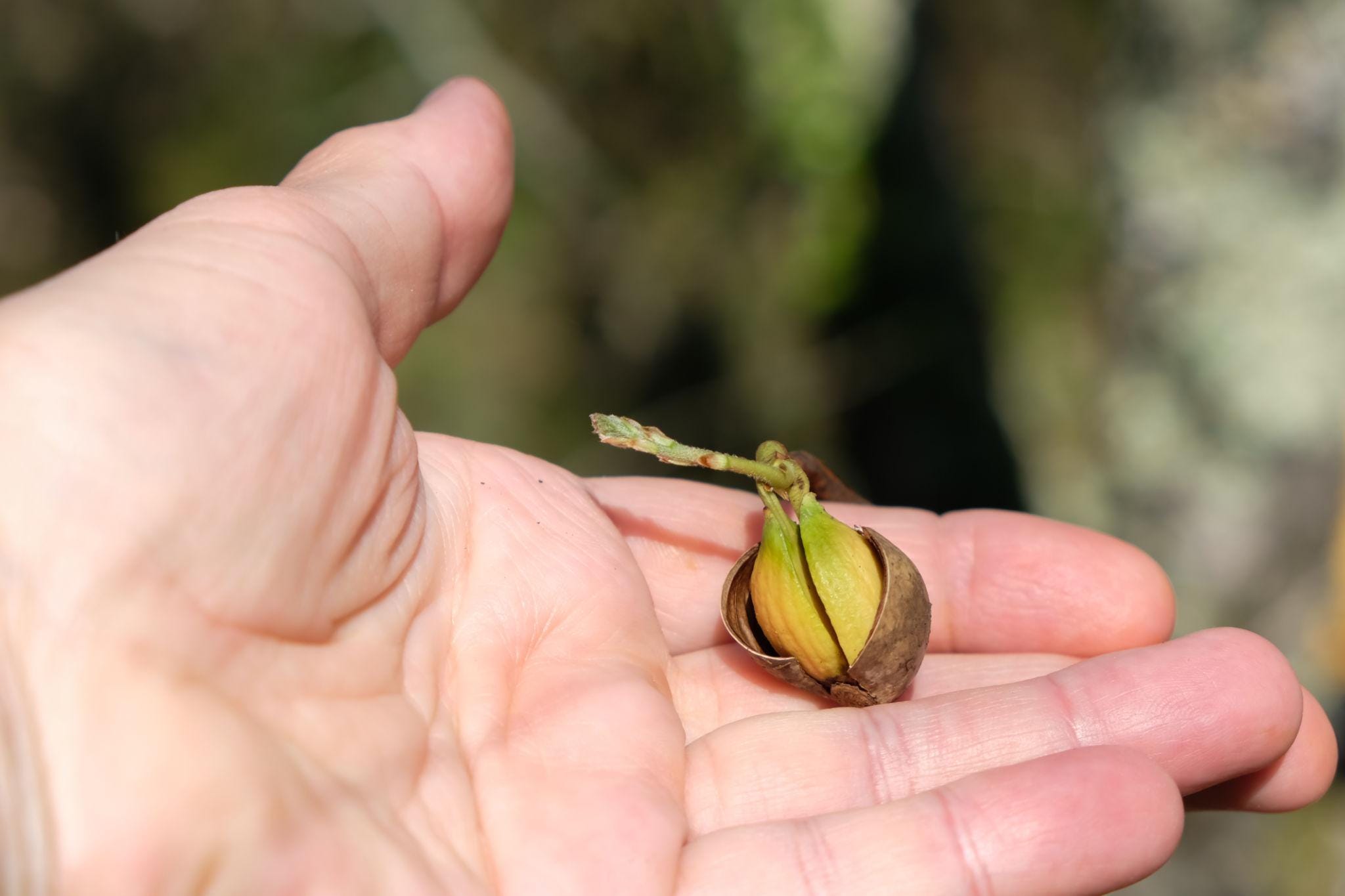
He ran his hands through the soil, turning it slowly, like he was searching for something hidden in it. When he found a small nut, he held it up.
“Do you know what this is?” he asked.
She glanced at it but didn’t answer.
“It’s the start of something,” he said, rolling it gently between his fingers. “Doesn’t look like much, does it? Not a flower, not a fruit, not even a leaf. But everything it needs to be a great tree is already in there.”
She frowned. “It doesn’t look like a tree.”
“No, it doesn’t,” the Gardener agreed, rolling the nut between his fingers. “But it’s in there, hidden. If we plant it in good soil, give it water and sunlight, it’ll grow. It doesn’t have to try to be a tree. It doesn’t have to be ‘right’ first. It just grows.”
He held it up higher so she could see it clearly. “It doesn’t need anyone to see it. It doesn’t need anyone to call it good. It just grows. No one tells it how. It grows because that’s what it’s meant to do.”
The Little Girl frowned, rubbing her hands together. “But I’m not like that,” she said. “I’m not good at growing.”
The Gardener gave a soft laugh. “You’ve grown more than you know,” he said. “Nuts start growing underground. No one sees them, but they still reach deeper, still get stronger. Just because you can’t see it doesn’t mean it’s not happening.”
The Little Girl’s fingers picked at the frayed edge of her dress again. “But I still feel empty. It’s like I left something behind when I left them. Something I can’t get back.”
The Gardener tilted his head, watching her closely. “What do you think it was?”
Her breath came in slow, shaky pulls. “I don’t know,” she whispered. Her voice was brittle. “It felt like... I belonged, like I had purpose, like I was seen and significant. I felt protected and part of something bigger than me. Like something was full inside me for a little while. But it’s gone now.”
The Gardener nodded, as if she’d told him something he already knew.
He glanced at her, his eyes warm and steady. “Do you know who made the nut?”
The Little Girl shook her head.
“Me neither,” the Gardener said with a smile. “And it wasn’t the people who built the garden wall. It’s something we can’t see. Some people call it life. Some call it spirit. Some call it God. It’s not a person with hands and eyes like you and me, but it’s real. It moves through everything. The trees, the flowers, the insects, even you.”
The Little Girl looked up at him, her eyes wide with wonder. “Inside me?”
“Inside you,” he said firmly. “Right now. Not because you tried hard. Not because anyone said you were good enough. Just because you are.”
Her brow furrowed as she thought about this. She brushed her dirty fingers over her arms, over the places she imagined her crosses to be. “Even with my crosses?”
“Even with your crosses,” the Gardener said. He leaned in close like he was telling her a secret. “The life inside you isn’t afraid of your crosses. It’s stronger than that. It’s older than them. It’s the same life that makes the nut grow, that makes the trees grow tall and wide. It doesn’t go away just because someone says you’re not ‘right.’”
Her fingers twitched in the dirt. “But it feels like it’s gone.” Her voice was so small it could have been a breeze. “I feel like it’s gone, and I’m scared I’ll never feel it again.”
The Gardener didn’t speak right away. He glanced at the sky, where clouds moved slowly, stretching into shapes that didn’t stay.
“Do you know how we tell where the wind is?” he asked suddenly.
Her brow furrowed. “We feel it.”
“Not just that,” he said. “We see it move the leaves. We watch the way it shakes the grass or ripples the water. We don’t see the wind itself. We see its work.”
He pressed his hand into the soil and lifted it, letting the dirt fall through his fingers. “It’s like that with what you’re missing. Some people call it God. Some call it spirit. Some call it the breath of life. It doesn’t have a single name, and it doesn’t belong to just one place or one people. It moves in you, like it moves in me. You felt it once, and you think it’s gone, but it’s not gone.”
Her gaze dropped to her hands, as if she might see it there. “But I don’t deserve it.”
“Exactly,” he said, grinning. “You don’t have to.”
Her eyes widened at that. She stared at him like she wasn’t sure she’d heard him right.
“But the people at church said—”
“People say a lot of things,” he interrupted gently. “They name everything. Good. Bad. Right. Wrong. They name flowers weeds and weeds flowers, and half the time, they’re wrong.”
He picked up a small dandelion that had sprouted by the path.
“They call this a weed,” he said, holding it up, “but it feeds the bees and heals the soil. Just because someone calls something bad doesn’t make it so.”
Her gaze flickered back to her own hands, tracing the spaces where she imagined her crosses lay. “So... if they called me bad…”
The Gardener nodded. “They got it wrong.”
The Gardener watched her with that quiet, steady look that never wavered. “Words, names, labels are just sounds people make with their mouths,” he said. “They can help us talk about things, but they aren’t the thing itself. You could call it ‘garden’ or ‘world’ or ‘universe,’ and it would still be all of this.”
He spread his hands wide.
“The life inside you doesn’t care what name you give it. It’s still there. The same life that’s in the nut, in the tree, in me.
“You called it ‘God’ before, and that’s a fine name. It’s a good name. But if the people who told you about God didn’t see the life in you, maybe they forgot how to look. Maybe they forgot that the crosses people carry aren’t always something to be fixed. They’re just part of being alive.”
Her lips pressed together. Her eyes shone like water catching light.
“So... if I call it ‘God,’ it’s still there. And if I call it ‘Life,’ it’s still there. Even if I don’t know what to call it, it’s still there?”
“Yes,” he said with a smile. “It’s still there. It doesn’t leave, even if people do.”
Her face crumpled, and tears came suddenly, pouring down her cheeks like rain.
The Gardener leaned forward until their foreheads almost touched. His voice was no louder than a breath.
“It is you,” he said. “Not something outside you. Not something you have to earn. Just like the nut, it grows in you, with you, as you.”
Her breath caught. Her shoulders shook. And for the first time, she let herself lean into him, resting her head against his arm. He didn’t move, didn’t shift, didn’t make her let go. He just sat there, like a tree letting a tired bird land on its branch.
Her breath was slow and steady now, matching the rise and fall of his own. She felt, for the first time in a long time, something quiet, something full, pressing in her chest. Not a thing that had been given, but something that had always been there.
“What do I call it?” she asked.
The Gardener leaned his head back, gazing up at the clouds drifting slowly overhead.
“Call it what you like,” he said. “Call it God. Call it breath. Call it YOU.”
The Little Girl closed her eyes, her fingers still in the soil, her heartbeat soft and steady in her chest.
For the first time, she didn’t feel empty.
She didn’t need a name for it.
She knew it was there.
Beyond the Garden
I think many people may recognise parts of this story in their own lives, because leaving something controlling or harmful is rarely as simple as just walking away.
For me, the grief was not only about the people or the beliefs themselves, but about what those spaces once gave me: belonging, certainty, purpose, protection, identity. Even harmful places can meet very real human needs, and losing them can feel frighteningly empty at first.
Although this story centres around church and faith, what I am really writing about is something larger than religion alone. I am writing about the slow and painful realisation that I had handed other people the power to define whether I was worthy, lovable, good, or spiritually “acceptable.” Over time, I began to understand that life, love, spirit, and worth were never truly theirs to give or take away in the first place.
Slowly, I began to wonder whether the thing I was searching for had ever really gone at all.
Whether it had simply become buried beneath shame, fear, and other people’s voices.
Like the nut in the story, something living may have been there long before anyone called me broken.
what a beautiful story. i have also felt so drawn to the image of a seed cracking open. it feels so very aligned with the work we are doing in our inner healing, in our becoming. so glad we get to do it together here. we get to heal out loud. no longer suffering in silence. sending a big hug your way. 🥰
This is so crucial. And that quote from Julian of Norwich is perfect. She saw a lot very, very clearly. This small nut in the hand looks tiny but is the world.