
August: Choosing what endures
Notes From My Garden

July is a month of abundance. August is a month of decisions.
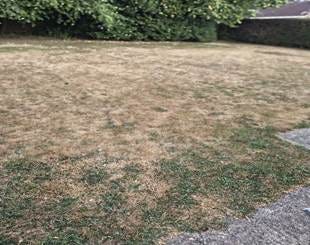
Looking across the garden now, it would be easy to think summer is coming to an end. The grass is brown, the lilies, aquilegias and poppies have died back, leaving behind little more than dry stems and empty seed heads. Much of the colour has faded.
There has been no rain since I last wrote about the garden in July.
The grass that was once soft beneath bare feet is now the colour of straw, sharp and scratchy underfoot. The daisies have vanished, along with the clover and dandelions that sprinkled the lawn with white, purple and yellow. At first glance the garden looks exhausted, as though summer has already passed it by.
But look a little closer and you see something different. The garden is not dying. It is choosing how to survive.
The roots are still there, waiting. One good downpour and the grass will green almost overnight. The wildflowers will return as though they had never left.
Each evening I begin my nightly ritual of watering, recycling the water we have used during the day. Before it disappears down the drain, bathwater, shower water and the last of the washing-up water are carried outside in watering cans. One by one I walk around the garden, deciding who needs it most.
In August there is never enough water for everything.
The lawn has to fend for itself, as do many of the established borders. The precious water goes to the vegetable beds, the grapevine and anything newly planted. Gardening through a dry summer becomes an exercise in choosing where life has the best chance of continuing.
Some plants have already learnt to care for themselves.
Five years ago we planted a silver birch at the bottom of the garden. These days I rarely water it. Long ago its roots found the underground stream that quietly runs beneath the garden, drawing up water I cannot even see.
Beneath the garden lies an old well. Every year I think about restoring it so I can use the water again, and every year I decide against it. Its water is not wasted. Hidden below the surface, it sustains the trees and shrubs, encouraging their roots to grow deep and making them stronger when the winter storms arrive.
The apple tree is a little too far away to benefit from that hidden water and has to work harder to survive. It cannot sustain every apple it has set. Each morning more small, unripe fruit lies scattered across the brown grass.
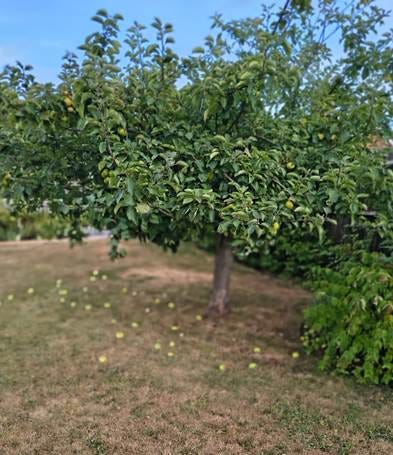
For a while I wondered what was wrong. Each morning, I picked up another handful of tiny apples and searched the tree for signs of disease. Then I realised nothing was wrong at all. The tree was simply doing what it had to do. It was letting some fruit go so the rest had a chance to grow large and sweet.
The flower borders are beginning to change. The ox-eye daisies, poppies and aquilegias have all but disappeared now, their browning seed heads releasing seeds into the breeze, spreading round the garden in preparation for next year’s display.
The day lilies that only weeks ago filled the borders with burnt orange and deep chocolate flowers are fading too. Their brief moment has passed, but their leaves remain, slowly yellowing as they feed next year’s tubers beneath the soil.
Yet just as some flowers are leaving, others are stepping forward.
The hibiscus has never looked better.
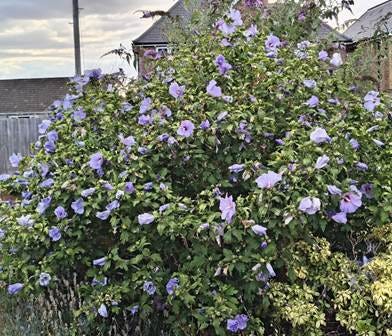
For nearly ten years it lived in a pot. It survived, but that was all. It flowered occasionally but never really grew. When we created a new border I planted it as an afterthought, leaving it to compete with the buddleia and the azalea for space.
Eventually it found its place.
Now, every August, it rewards me with enormous rich purple flowers. Looking back, I realise there was never anything wrong with the hibiscus. It simply spent ten years trying to survive in the wrong place.
I loved it enough to try an orange variety too, but that one never survived. Our winters were too wet, our summers too dry, and perhaps I expected too much of it before it had established itself. It simply didn’t have the strength to cope with such harsh conditions.
Outside Mike’s therapy room grows a beautiful pink hibiscus. Every summer I stop to admire it as I arrive. In a few weeks’ time I’m hoping to take a cutting. If it takes, perhaps next August another hibiscus will have found its place here too.
The osteospermums continue to astonish me. Pink, white and orange flowers still brighten the borders despite the heat. Earlier this year they were cut back brutally while our driveway was being relaid. They have returned as though nothing had happened. Some plants possess a determination that is impossible not to admire.
The sunflowers have begun their annual performance. One flower opens while another is already fading. Their great heads follow the sun across the sky before eventually bowing under the weight of ripening seed. Those seeds will feed the birds through winter before the wind scatters what remains to begin the cycle once again.
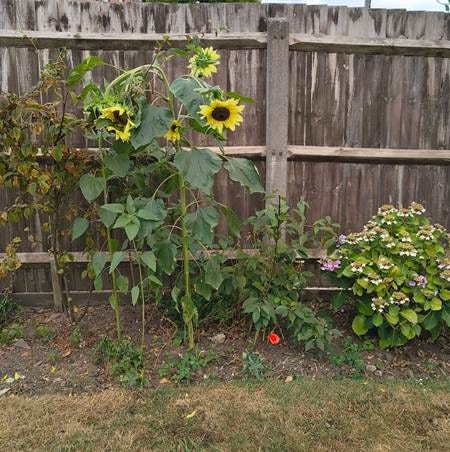
And this year, after years of waiting, I finally found a single red poppy.
Orange, deep chocolate and pink poppies have seeded themselves around the garden for years, but the classic scarlet poppy had always eluded me. Then, one morning, it appeared.
Even after twenty-five years this garden still knows how to surprise me.
While the flower borders begin to tire, the vegetable garden is only just reaching its peak.
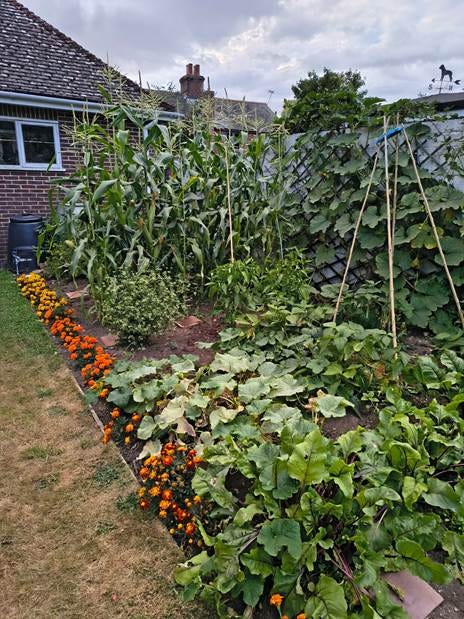
The sweetcorn now stands well over six feet tall, each plant carrying two cobs that are almost ready to harvest. The grapevine has revelled in the sunshine too. Heavy bunches of grapes hang beneath the leaves, more than I can ever remember, slowly swelling day by day.
The squash has taught me something this year. Several flowers set fruit at the same time, but the plant lets most of them die back, pouring all its energy into just a few. Meanwhile, the vines continue to scramble through the sweetcorn and across every spare inch of soil. Even the squash seems to understand that there are seasons when concentrating on fewer things produces the better harvest.
Our newest experiment has been cucamelons. Tiny fruits no bigger than gooseberries, looking like miniature watermelons and tasting of cucumber with a hint of lemon. They have been an unexpected delight, scattered through salads or dropped into summer drinks.
The beech trees have begun dropping their cob nuts. Years ago, I would have opened every one to find the tiny beech nuts hidden inside. These days I leave them where they fall and hope the squirrels discover them before I do.
The birds are as busy as ever.
The blackbirds and greenfinches have fledged and chatter noisily from every corner of the garden. The collared doves continue their noisy courtship, wings clattering together in the tree canopy, much to the amusement of my grown-up children..., while high in the beech tree another nest holds newly hatched chicks whose parents make endless journeys backwards and forwards with food.
My garden may not look its best now. Much of its colour has faded and many of the flowers that filled July have quietly disappeared. Yet beneath the surface it is working harder than ever. Roots reach deeper in search of water, seeds ripen quietly in their drying heads, fruit swells in the late summer sun and plants decide what they can carry and what they must let go. Everywhere there is preparation for the seasons still to come.
Not everything that looks dry is dying.
Sometimes life is simply happening somewhere you cannot yet see.
I'll meet you here again next month to see what September brings.
July: Between Flower and Harvest

You’ve wandered with me through the symbolic garden of the Little Girl and the Gardener, and more recently through the stories hidden inside individual flowers.
Nat, this is gorgeous.
The garden and what grows, doesn’t, and seems like it doesn’t, is such a juicy metaphor for life.
Certain flowers are not necessarily dying, they are “choosing how to survive”. Yes! Just as some are leaving, some others are “stepping forward”. This made me think of the state of some of my friendships in this time in my life.
Growth and life and love are sometimes not visible, but there, often, nevertheless. And … where something leaves us, a space is opening up for something new, perhaps.
“Not everything that looks dry is dying.” I love this. The apple tree letting go of some of its fruit so the rest can grow, the squash concentrating its energy, the roots reaching for water we can’t see — you let the garden make the argument without forcing the metaphor. Beautifully done.